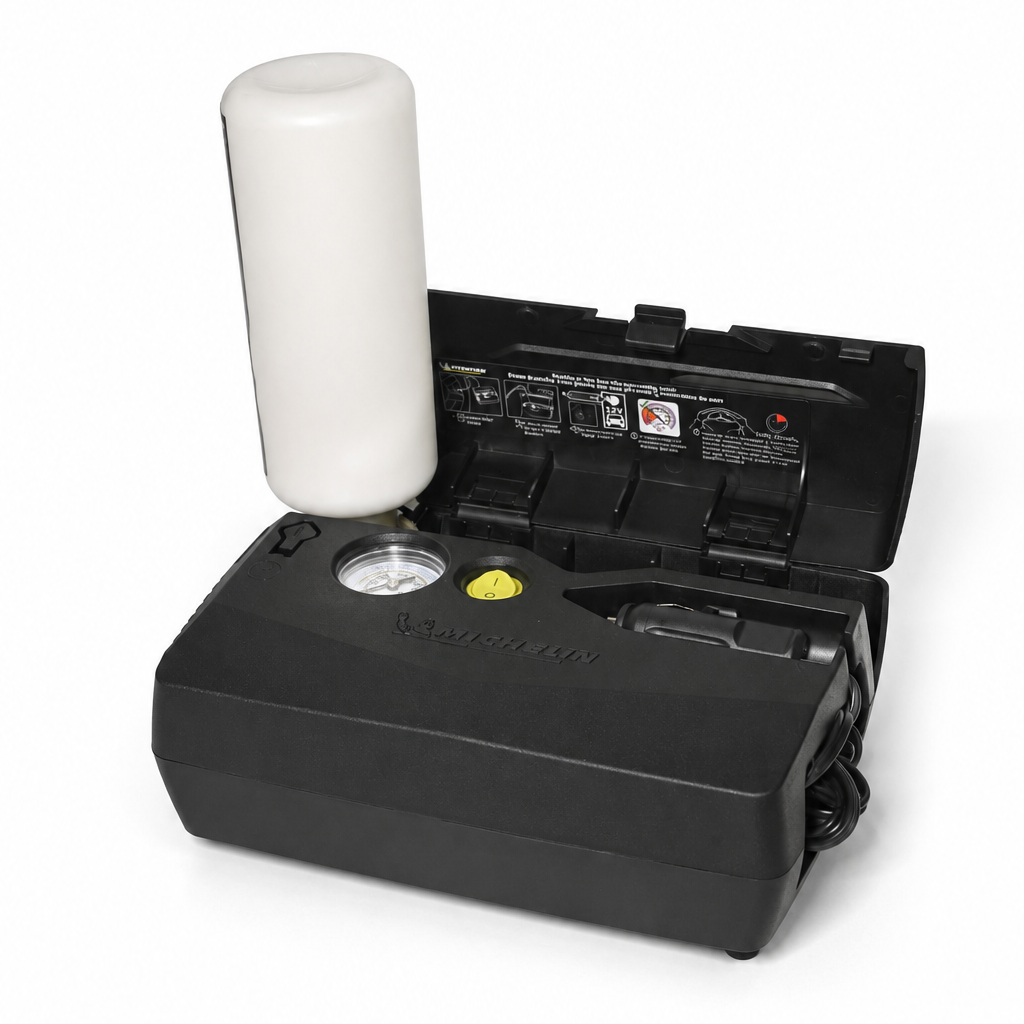
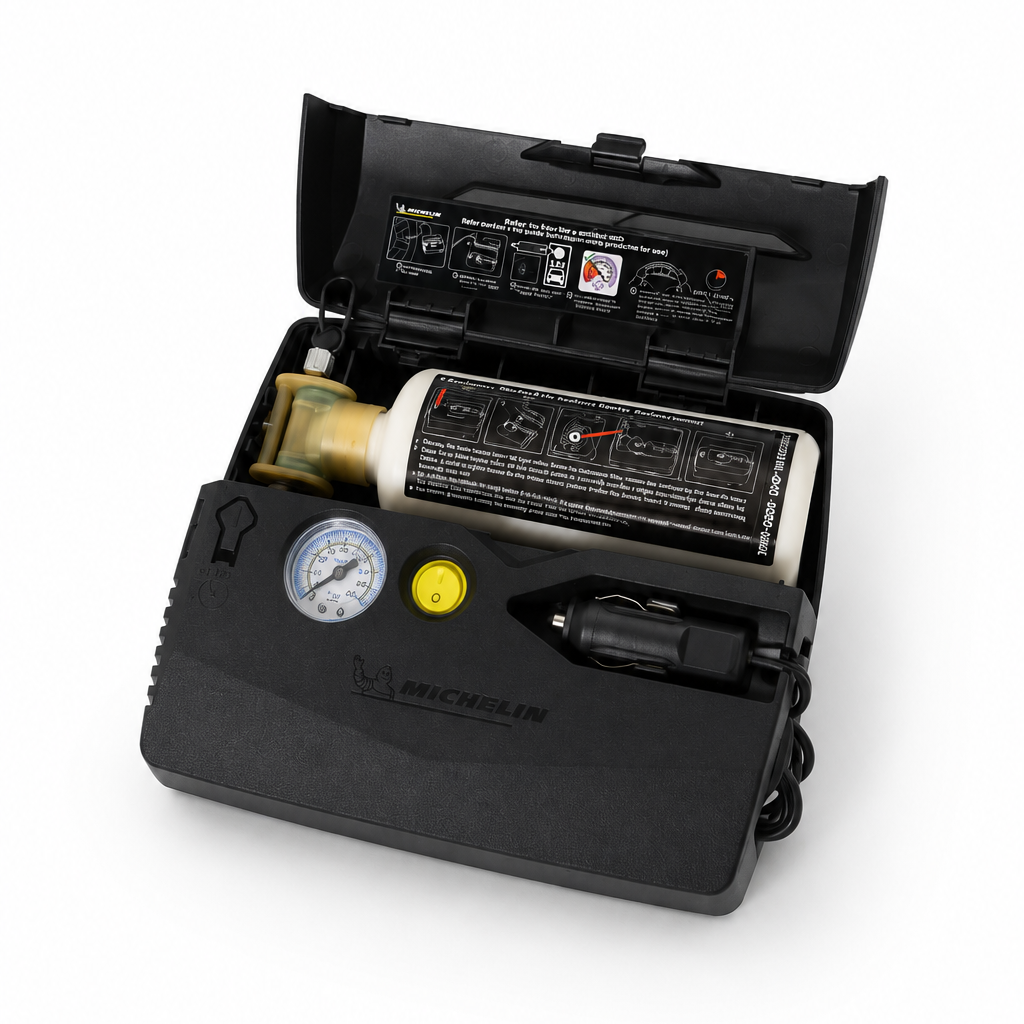
SEALANT REPAIR OPERATION
1. Be sure to park the car in a safe location, away from any personal risk.
2. Take out the inflating hose and power cord from the inflator's compartment.
3. Open the sealant bottle compartment cover and lift the bottle to an upright position.
4. Connect the inflating hose nozzle to the tyre valve connector. If done correctly, the current pressure will be indicated on the inflator's pressure gauge within a few seconds.
Attention: When screwing on the nozzle, do so accurately. If not, unscrew the nozzle and try again.
5. Insert the inflator's power cord plug into the car's 12V cigarette lighter socket, and start the car engine.
6. Press the On/Off button to start the tyre inflator. Initially, the tyre gauge pressure will reach approximately 60 PSI as the sealant is discharged into the tyre. After the sealant is injected, the gauge pressure will decrease to around 20 PSI and will then gradually increase to the recommended (placard) pressure. Depending on your tyre size, the total repair time could take up to 15 minutes. The correct tyre pressure can be found on the placard inside the driver's side door jamb. Once you reach the correct tyre pressure, turn the power button to the "off " position.
7. Turn off the inflator's power button and switch off the car engine. Remove the inflator's nozzle and rotate the screw nut back to its original position.
Attention: When removing the hose, a small amount of sealant may escape. Avoid contact with the sealant.
8. Start the car engine and drive for about 10 minutes. Then, to check the actual tyre pressure, connect the inflator's hose nozzle to the tyre valve connector and read the pressure on the gauge.
9. STOP the vehicle and connect the air hose to the tyre. If the pressure is above 32 PSI, the vehicle can be driven to the destination at a maximum speed of 80 km/h (50 mph). Seek out a professional tyre repair or replacement before any further journeys.
10. If the pressure is lower than 32 PSI but higher than 19 PSI, inflate the tyre again to approximately 36 PSI. Drive the vehicle for another 10 minutes at a maximum speed of 80 km/h (50 mph). Stop and check the pressure again. If the pressure is now above 32 PSI, the vehicle can be driven to the destination at a maximum speed of 80 km/h (50 mph). Seek out a professional tyre repair or replacement before any further journeys.
Inflation Operation
1. Be sure to park the car in a safe location and keep people away from any risk.
2. Remove the inflating hose and power cord from the slots of the inflator.
3. Connect the inflating hose to the tyre valve. Within a few seconds, the tyre pressure will be indicated by the inflator's pressure gauge.
Attention: If the nozzle screw nut does not properly fit the tyre valve connector, remove the nozzle from the connector and screw it on again.
4. Insert the inflator's power plug into the car's 12V cigarette lighter socket, then start the car engine.
5. Press the On/Off button to begin operation. When the tyre pressure reaches the vehicle manufacturer's recommended value (usually around 36 psi), refer to your vehicle's instructions for confirmation, and then turn off the inflator.
6. Wait for 10 minutes to check that the tyre pressure remains stable. Compare the pressure reading to the recommended value. If the tyre pressure does not reach the manufacturer's specified range (usually about 36 psi), repeat step 5.
7. To prevent the nozzle and inflator from overheating, do not operate the inflator for more than 10 minutes at a time. After each 10-minute session, allow the inflator to cool for 15 minutes.
8. Once inflation is complete, unplug the inflator from the car's cigarette lighter socket and return it to the inflator's storage slot.
If the tyre continues to leak after several inflations, it is recommended to park the car in a safe area and call for emergency roadside assistance to tow the vehicle to a nearby garage for repair.
DEFLATING OPERATION
If, during inflation, the tyre pressure becomes too high, keep the air hose nozzle connected to the tyre valve. Press the deflating knob to reduce the pressure to the desired value.
REPLACING SEALANT BOTTLE
1. Remove the hose nozzle from the tyre valve, press the deflating valve, and release the remaining air in the air hose.
2. Open the compartment cover, lift the sealant bottle to an upright position, rotate it counterclockwise, and remove the bottle. You may hear a sound due to residual pressure inside the bottle, which is normal. Avoid contact with the sealant.
3. Ensure that the two seals in the grooves of the upside-down bottle cover are properly inserted. Then, rotate the upside-down bottle clockwise onto the bottle cover inside the inflator compartment.
4. Lay the sealant bottle down horizontally and close the compartment cover.